
If you’ve ever wondered how many weeks in a year, you’re definitely not alone. This is one of those surprisingly common questions that shows up in school, office planning, payroll systems, budgeting, and even project management.
At first glance, it feels like a simple math question. However, once you include leap years, salary calculations, or biweekly payroll systems, the answer becomes a little more interesting than expected. So, let’s break it down in a clear and easy way.
How Many Weeks Are in a Year?
To begin with, a normal year has:
- 365 days in a common year
- 366 days in a leap year
Since every week contains 7 days, we can calculate:
- 365 ÷ 7 = 52 weeks + 1 day
- 366 ÷ 7 = 52 weeks + 2 days
So, what’s the real answer?
A year contains 52 full weeks, plus a small extra portion of days.
In simple terms, whenever someone asks how many week in a year, the most practical answer remains 52 weeks.
Why a Year Doesn’t Divide Perfectly into Weeks
Interestingly, the calendar system is not designed to match perfectly with weeks. Because of this, every year leaves a small remainder after dividing by 7.
As a result:
- Every year has 52 complete weeks
- Plus 1 or 2 extra days
- These extra days shift the calendar forward each year
For instance, this is exactly why New Year’s Day never falls on the same weekday every year.
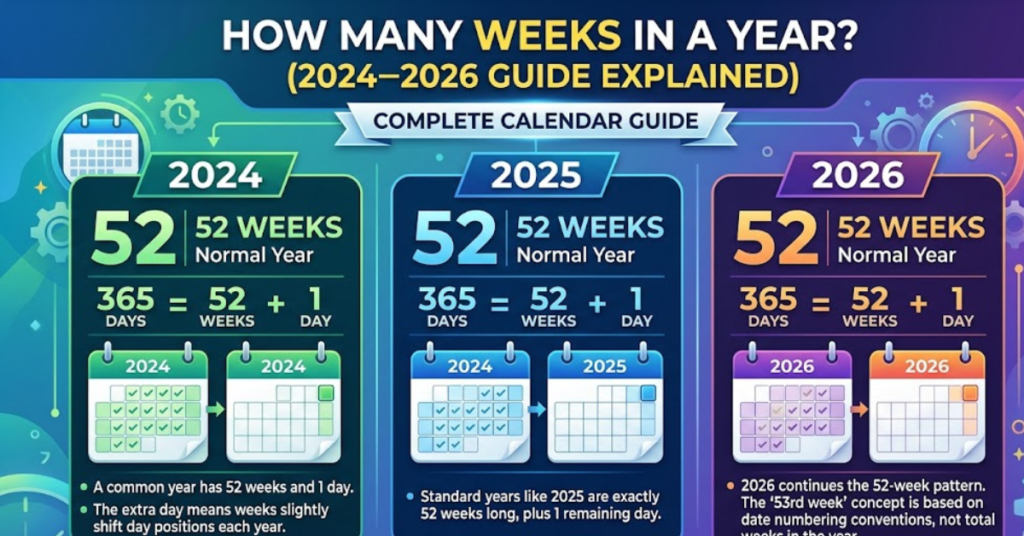
How Many Weeks in a Year 2024, 2025, and 2026?
Now let’s look at specific years, since many people search for exact breakdowns.
Year 2024
2024 is a leap year, which means:
- It has 366 days
- Therefore: 52 weeks + 2 extra days
So, in practical terms, it still equals 52 full weeks, just with an additional day adjustment.
Year 2025
2025 is a normal year:
- It has 365 days
- That results in 52 weeks + 1 day
Year 2026
Similarly, 2026 is also a common year:
- 365 days
- Again, 52 weeks + 1 day
So overall, no matter which year you check, the weekly structure stays almost identical.
How Many Weeks in a Year for Payroll?
When it comes to salary and HR systems, things get slightly more structured.
Typically, companies use:
- 52 weeks per year for payroll calculations
- In some cases, 52.14 weeks for more precise financial accuracy
This helps organizations calculate:
- Weekly wages
- Annual salary breakdowns
- Tax deductions
- Employee leave balances
Therefore, when someone asks how many week in a year for payroll, the standard answer is still 52 weeks, even though small adjustments may be used in accounting.
How Many Weeks in a Year for Biweekly Pay?
Biweekly simply means “every two weeks.” So, naturally:
- 52 weeks ÷ 2 = 26 pay periods
Final answer:
There are 26 biweekly pay cycles in a year
This is why many employees receiving biweekly salaries are paid 26 times annually.
Other Useful Week Calculations
To make things even clearer, let’s explore some related breakdowns.
How many weeks in a year and a half?
First, we calculate:
- 1 year = 52 weeks
- Half year ≈ 26 weeks
So, 1.5 years ≈ 78 weeks
weeks in a year divided by 2?
- 52 ÷ 2 = 26 weeks
This is often used in budgeting and semester planning.
weeks in a year without weekends?
If we think in working terms:
- 52 weeks × 5 working days = 260 working days
Even though weekends are excluded, the number of weeks technically remains the same.
However, productivity planning becomes more accurate using working days instead.
How many weeks in a year and days?
Every year consists of:
- 52 weeks + 1 or 2 extra days
This depends on whether it is a leap year or not.
How to Calculate Weeks in Any Year
If you ever want to calculate it yourself, here’s a simple method:
- Take total days in the year (365 or 366)
- Divide by 7
- The result will always be 52 full weeks
- Add remaining 1 or 2 days
So, there’s no need for complex formulas—it’s very straightforward.
How Many Weeks Are Left in a Year?
This depends entirely on the current date.
For example:
- Mid-year → around 20 to 30 weeks left
- End of year → only a few weeks remaining
This calculation is especially useful for:
- Goal tracking
- Financial planning
- Academic schedules
- Business forecasting
How Many Weeks in a Year for Salary Calculation?
In salary systems, consistency matters more than exact precision.
That’s why most companies assume:
- 52 weeks per year
- Occasionally 52.14 weeks for accounting precision
This helps convert:
- Annual salary → weekly income
- Monthly salary → weekly breakdown
Frequently Asked Questions (FAQs)
1. How many weeks are in a year exactly?
A year contains 52 full weeks plus 1 or 2 extra days.
2. How many weeks are in a leap year?
A leap year has 52 weeks and 2 extra days.
3. How many biweekly pay periods are in a year?
There are 26 biweekly pay periods annually.
4. Why is a year considered 52 weeks?
Because 52 × 7 = 364 days, which is very close to a full year.
5. Can a year ever have 53 weeks?
Yes, in rare accounting calendar systems, a year may be counted as 53 weeks depending on how days align.
Conclusion
To wrap it up, the question of how many weeks in a year has a simple but interesting answer.
A standard year always has 52 weeks, with a small remainder of days depending on whether it is a leap year or not. However, when we apply this concept to real-life situations like payroll, budgeting, or scheduling, the number 52 becomes a very practical and reliable standard.
So whether you’re planning finances, tracking work schedules, or simply satisfying curiosity, understanding this basic time structure helps you stay more organized and informed throughout the year.