
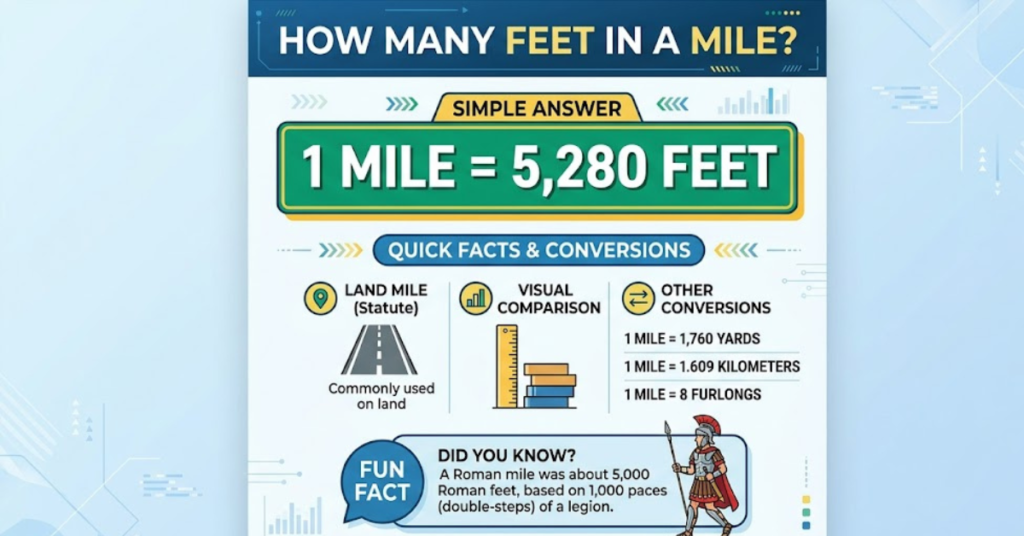

Ever found yourself wondering how many feet are in a mile—whether you’re walking, running, or just trying to settle a quick debate? You’re not alone. It’s a common question with a surprisingly interesting backstory.
In this guide, we’ll break it down in plain English, explain where the number comes from, and share a few easy ways to remember it.
The Exact Answer
Let’s keep it simple:
There are exactly 5,280 feet in a mile.
This is a fixed measurement used in the United States and a few other countries that follow the imperial system. It’s precise—not an estimate—so you can rely on it every time.
Why Is a Mile 5,280 Feet?
At first glance, 5,280 feels like a random number. It’s not.
The origin goes back to ancient Rome, where distance was measured in “mille passus” (1,000 paces). Later, England refined the system. In 1593, the mile was standardized based on:
- 8 furlongs per mile
- 660 feet per furlong
Multiply those together:
- 8 × 660 = 5,280 feet
That’s the exact value still used today.
Does the Distance Change When Walking or Running?
Short answer: no.
A mile is always the same length, but how you experience it depends on the activity.
Walking
- Distance: 5,280 feet
- Steps: around 2,000–2,500
- Time: about 15–20 minutes
Running
- Distance: unchanged
- Faster pace, fewer steps
- Time: roughly 7–12 minutes
Driving
- Covered quickly, usually within a couple of minutes in city traffic
Swimming
- Same total distance
- About 35 lengths in an Olympic-size pool
So whether you’re walking, running, or swimming, the measurement stays constant.
How Many Feet in a Mile and a Half?
For longer distances, the math is straightforward.
1.5 miles = 7,920 feet
Quick calculation:
- 5,280 × 1.5 = 7,920
This is one of the most commonly searched variations—and now you can calculate it instantly.
Easy Ways to Remember the Number
If 5,280 doesn’t stick right away, try these tricks:
1. The “Five Tomatoes” Trick
Say it like this: five-to-ma-toes → 5-2-8-0
2. Break It Into Parts
Think of it as:
- 5,000 + 280
3. Visual Reference
Picture roughly:
- 18 football fields (including end zones)
These simple associations make the number much easier to recall.
Does Gender or Speed Affect the Distance?
You might see variations of this question, but the answer is straightforward:
The distance of a mile never changes.
What can vary:
- Step length
- Walking or running speed
- Time taken
So while individuals may experience the distance differently, the measurement itself remains fixed.
Has This Measurement Ever Changed?
Not in modern times.
The value of 5,280 feet has been standardized for centuries. While older systems varied long ago, nothing has changed in recent history.
Quick Conversion Guide
Here are some useful reference points:
- 1 mile = 5,280 feet
- 0.5 mile = 2,640 feet
- 1.5 miles = 7,920 feet
- 2 miles = 10,560 feet
You can use these as quick mental calculations without needing a calculator.
FAQs
1. Why is a mile 5,280 feet?
It comes from combining furlongs and feet in the old English measurement system.
2. Does walking change the distance?
No, it only affects how long it takes to cover the mile.
3. Is running distance different from walking?
No, both cover the same total distance.
4. How many feet are in 1.5 miles?
That equals 7,920 feet.
5. Is this measurement used worldwide?
No, most countries use kilometers instead of miles.
6. Is 5,280 an exact number?
Yes, it’s an exact and standardized value.
Conclusion
So, how many feet are in a mile? The answer is simple: 5,280 feet.
Once you understand where the number comes from and how to remember it, it becomes second nature. Whether you’re tracking your steps, planning a run, or just satisfying curiosity, this is one conversion worth knowing.
If you’re interested in more easy conversions or practical measurement guides, there’s plenty more to explore.