
Ever found yourself mid-recipe wondering how many teaspoons in a tablespoon? You’re definitely not alone. In fact, this is one of the most searched kitchen conversion questions—and for good reason. Whether you’re baking cookies, measuring spices, or adjusting a recipe, accuracy really matters.
In this guide, we’ll break down teaspoon-to-tablespoon conversions in a simple way. Additionally, we’ll explore differences across countries and show how this measurement applies to ingredients like sugar, butter, flour, and water.
How Many Teaspoon in a Tablespoon?
Let’s start with the basic rule:
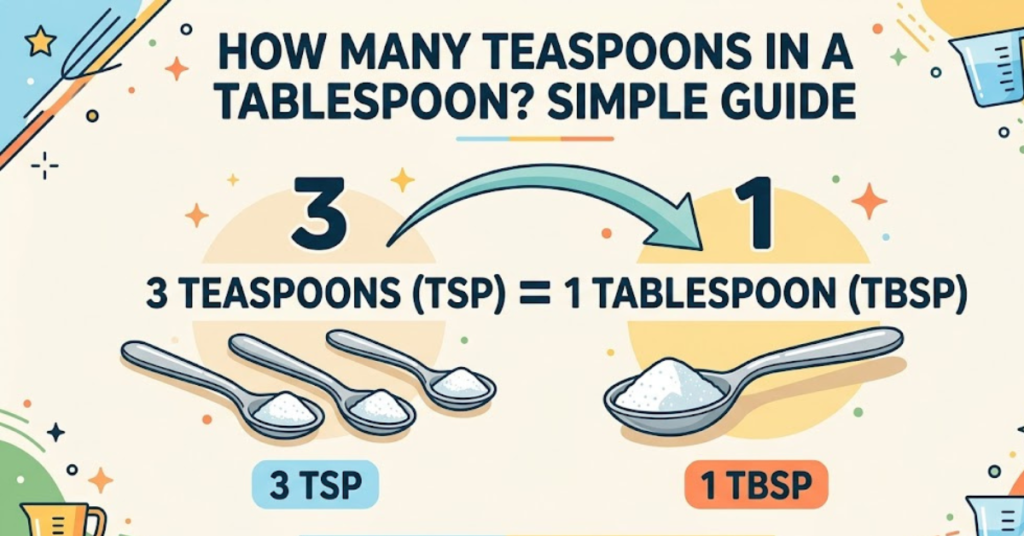
1 tablespoon = 3 teaspoon (US standard)
In most cases, especially in American recipes, this is the standard conversion you’ll rely on. So whenever you see a tablespoon measurement, you can confidently convert it into three teaspoons.
Why This Conversion Matters in Cooking
Although it may seem like a small detail, accurate measurement plays a big role in cooking and baking. Even a slight variation can affect the final result.
For example, incorrect measurements can impact:
- Taste of your dish
- Texture and consistency
- Overall balance of ingredients
Therefore, understanding this simple conversion helps you cook more confidently, even if you don’t have exact measuring tools nearby.
US vs UK vs Australia Measurement Differences
Interestingly, not every country uses the same system. Because of that, it’s important to know the differences.
United States
In the US system, the rule is simple:
1 tablespoons = 3 teaspoons
United Kingdom
Similarly, modern UK recipes follow the same standard. However, older recipes may vary slightly.
- 1 tablespoon (UK modern) = 3 teaspoons
As a result, most current recipes are aligned with US measurements.
Australia
On the other hand, Australia uses a slightly different standard:
- 1 Australian tablespoon = 4 teaspoons
So, if you’re cooking from an Australian recipe, you’ll need to adjust accordingly.
Ingredient-Based Conversions (Common Examples)
To make things even clearer, let’s apply this conversion to common ingredients.
Sugar
- 1 tablespoon of sugar = 3 teaspoons
Butter
- 1 tablespoons of butter = 3 teaspoons
Flour
- 1 tablespoons of flour = 3 teaspoons
Water
- 1 tablespoons of water = 3 teaspoons
In all of these cases, the conversion remains consistent. However, always remember that packing or scooping methods can slightly affect volume.
What About Half or One and a Half Tablespoon?
Sometimes recipes don’t use whole numbers. Instead, they call for fractions.
Here’s how to handle them:
- ½ tablespoons = 1.5 teaspoons
- 1½ tablespoons = 4.5 teaspoons
So, if you ever wonder about how many teaspoons in a tablespoon and a half, the answer is straightforward: 4.5 teaspoons.
Quick Kitchen Conversion Chart
To make cooking easier, here’s a simple reference guide:
- 1 tablespoon = 3 teaspoon
- 2 tablespoon = 6 teaspoon
- 3 tablespoon = 9 teaspoon
- ½ tablespoons = 1.5 teaspoon
Keeping this in mind will save you time during cooking.
Helpful Tips for Accurate Measuring
To improve consistency in your recipes, follow these practical tips:
- Always level off dry ingredients instead of heaping them
- Use proper measuring spoons for accuracy
- Measure liquids at eye level for precision
- Stick to one measurement system per recipe
Moreover, small habits like these can significantly improve your cooking results over time.
FAQs
How many teaspoons are in a tablespoon?
Generally, there are 3 teaspoons in 1 tablespoon in US and UK systems.
Is a tablespoon always 3 teaspoons?
Yes, in most countries it is. However, in Australia, it equals 4 teaspoons.
Does the conversion change for liquids?
No, liquids follow the same rule: 1 tablespoon = 3 teaspoons.
Why is Australia different?
Australia uses a slightly larger tablespoon measurement compared to US/UK standards.
How many teaspoon are in half a tablespoon?
Half a tablespoon equals 1.5 teaspoons.
Conclusion
In summary, understanding how many teaspoons in a tablespoon is a simple but essential kitchen skill. Most regions use the standard 3 teaspoons per tablespoon, although Australia is a notable exception with 4 teaspoons.
Ultimately, once you master this conversion, cooking becomes much easier and more accurate. So next time you’re in the kitchen, you’ll never need to guess again—just measure with confidence and enjoy better results every time.