
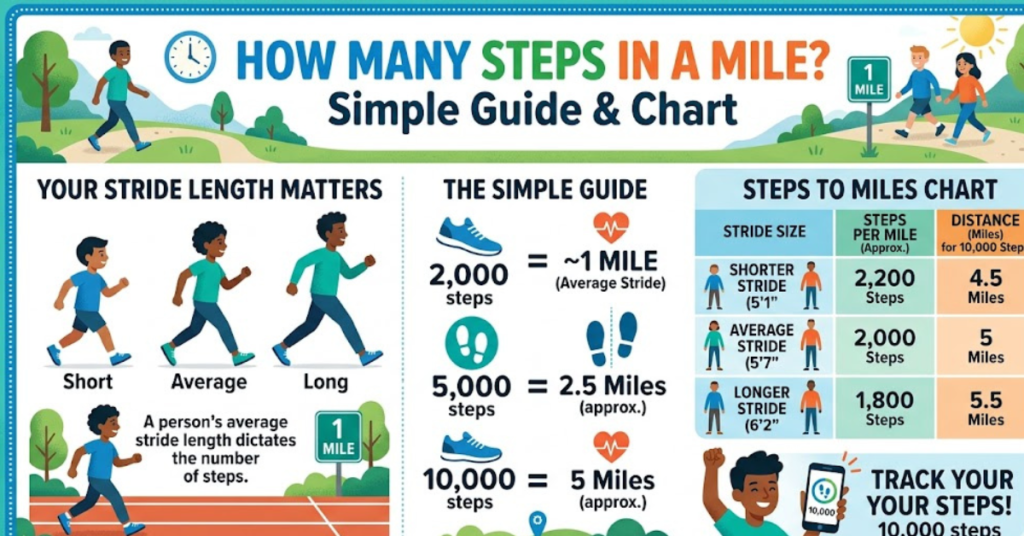

Ever checked your step counter and wondered how far you’ve actually walked? You’re not alone. Whether you’re aiming for 10,000 steps a day or just tracking your activity, knowing how steps translate into distance makes your progress feel more real.
The short answer: most people take between 2,000 and 2,500 steps to walk a mile. But that number isn’t the same for everyone—it depends on things like your height, stride length, and walking speed.
Let’s break it down in a way that’s easy to understand.
Average Steps Per Mile
If you just want a quick estimate, here’s a helpful guideline:
- Casual walking: 2,200–2,500 steps
- Moderate pace: 2,000–2,200 steps
- Running: 1,500–2,000 steps
For most adults, around 2,100 steps per mile is a solid average.
How Walking Speed Changes Your Step Count
Your pace has a direct impact on how many steps you take.
- Slow pace: shorter strides → more steps
- Normal pace: balanced stride → average steps
- Fast pace: longer strides → fewer steps
For example, a relaxed stroll might bring you closer to 2,400 steps per mile, while a brisk walk could lower it to around 2,000.
The Role of Height and Stride Length
Height plays a big role because it affects how long your stride is.
Shorter Individuals (around 5’2″)
- Typically 2,300–2,500 steps per mile
- Shorter legs = shorter steps
(around 5’6″)
- About 2,100–2,300 steps
- Falls within the average range
Taller Individuals (5’8″+)
- Around 1,900–2,100 steps
- Longer stride reduces total steps
Differences Between Men and Women
On average:
- Women: 2,200–2,400 step per mile
- Men: 2,000–2,200 step per mile
This difference mainly comes down to average height and stride length—not gender itself.
Walking vs Running
There’s a noticeable difference depending on how you move:
Walking
- Shorter strides
- More step per mile
- Easier to sustain over time
Running
- Longer strides
- Fewer steps (about 1,500–2,000 per mile)
- Higher intensity
Converting Steps to Longer Distances
Once you know your average, it’s easy to scale up:
- 1 mile: ~2,100 steps
- 1.5 miles: ~3,150 steps
- 10,000 steps: roughly 4–5 miles
How to Find Your Personal Step Count
If you want a more accurate number, try this:
- Measure a short distance (like 100 meters)
- Walk normally and count your steps
- Divide steps by distance
- Convert that into steps per mile
This gives you a personalized estimate based on your own stride.
Quick Reference Chart
| Height | Steps per Mile |
| 5’0″–5’3″ | 2,300–2,500 |
| 5’4″–5’7″ | 2,100–2,300 |
| 5’8″+ | 1,900–2,100 |
Why This Actually Matters
Tracking steps isn’t just about numbers—it helps you stay consistent and motivated.
Some key benefits:
- Better heart health
- Easier weight management
- Increased daily movement
- Clear, trackable goals
When you understand how steps translate into distance, your daily targets become more meaningful.
Read also <<< How Do Eels Reproduce? Life Cycle & Mystery Explained
FAQs
How many steps are in a mile on average?
Most people fall between 2,000 and 2,500 steps.
Does walking slower increase step count?
Yes, shorter strides mean more steps per mile.
How far is 10,000 steps?
Roughly 4 to 5 miles, depending on your stride.
Do shorter people take more steps?
Generally, yes—shorter stride length increases step count.
Final Thoughts
For most people, walking a mile takes somewhere between 2,000 and 2,500 steps. But instead of focusing on a perfect number, it’s more useful to understand your own pattern.
If you want the most accurate tracking, measure your stride once and use it as your baseline. From there, every step you take becomes a clearer measure of your progress.