
Ever wondered why some hair holds curls effortlessly while other strands stay pin-straight no matter what? The answer lies in understanding a hair texture chart. This simple yet powerful tool helps you identify your hair type, from fine and straight to coily and dense, so you can care for it properly.
In this guide, we’ll break down everything you need to know about hair textures, patterns, and how to use a hair texture chart to your advantage—without the confusion.
What Is a Hair Texture Chart?
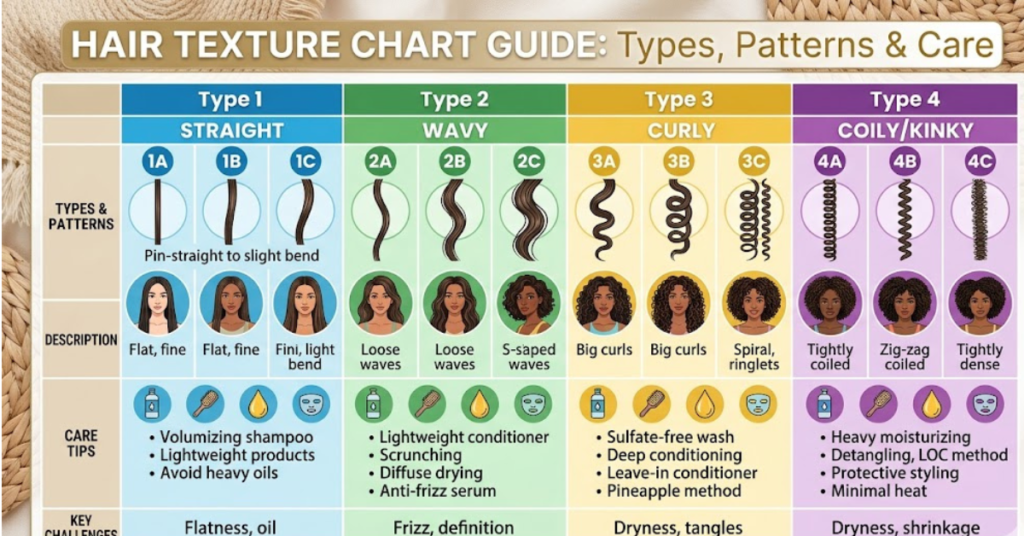
A hair texture chart is a classification system that groups hair based on its natural pattern and thickness. It usually combines two key elements:
- Hair pattern (shape): Straight, wavy, curly, or coily
- Hair thickness: Fine, medium, or coarse
Together, these factors determine how your hair behaves, responds to products, and holds styles.
Types of Hair Texture Chart Explained
1. Straight Hair (Type 1)
Straight hair has no natural curl pattern and tends to lie flat from root to tip.
Key traits:
- Reflects light easily (often looks shiny)
- Can become oily quickly
- Difficult to hold curls
Best care tips:
- Use lightweight products
- Avoid heavy oils
- Try volumizing shampoos
2. Wavy Hair (Type 2)
Often described as the “in-between,” wavy hair forms loose S-shaped patterns.
Subtypes:
- 2A: Slight waves, fine texture
- 2B: More defined waves with some frizz
- 2C: Thick waves, close to curly
This is where a chart hair texture chart wavy category becomes useful—it helps distinguish subtle differences.
Care tips:
- Use anti-frizz products
- Avoid over-brushing
- Enhance waves with light styling creams
3. Curly Hair (Type 3)
Curly hair forms defined loops or ringlets and tends to be more voluminous.
Subtypes:
- 3A: Loose curls
- 3B: Springy ringlets
- 3C: Tight curls with more density
A curly hair texture chart helps pinpoint your exact curl pattern for better styling.
Care tips:
- Deep condition regularly
- Use curl-enhancing creams
- Avoid sulfates
4. Coily/Kinky Hair (Type 4)
This category includes tightly coiled or zig-zag patterns, often seen in black hair texture chart systems.
Subtypes:
- 4A: Soft coils
- 4B: Z-shaped bends
- 4C: Tightest coils with shrinkage
You’ll often see variations like:
- black men hair texture chart
- black girl hair texture chart
- african american hair texture chart
These variations highlight how diverse and unique coily hair can be.
Care tips:
- Keep hair moisturized
- Use protective styles
- Minimize heat styling
Hair Texture by Thickness: Fine, Medium, Coarse
Beyond curl pattern, thickness plays a huge role.
Fine Hair
- Thin strands
- Prone to breakage
- Needs lightweight products
Medium Hair
- Balanced strength and flexibility
- Easy to style
Coarse Hair
- Thick strands
- Strong but prone to dryness
A hair texture chart fine medium coarse section helps you identify this dimension.
Hair Texture Chart for Men and Women
Hair texture applies to everyone, but styling needs can vary based on lifestyle and preferences. Understanding your texture helps you choose the right products and routines. It also makes daily hair care much easier and more effective.
Hair Texture Chart Men
Men’s hair textures range widely, from straight to tightly coiled. Each type responds differently to styling products, cutting techniques, and maintenance routines. Knowing your specific texture can help you achieve a cleaner, more manageable look without unnecessary effort.
Men often use texture charts for:
- Choosing the right haircut
- Beard blending
- Styling products
Common searches include:
- men hair texture chart
- hair texture chart black men
Hair Texture Chart Women
Women typically use it for:
- Hair care routines
- Curl definition
- Heat styling decisions
Both benefit equally from understanding their natural texture.
Specialized Hair Texture Charts
Baby Hair Texture Chart
Babies’ hair can change over time, but early textures may hint at future patterns.
Caucasian Hair Texture Chart
Usually includes:
- Straight to wavy types
- Fine to medium thickness
Black Hair Hair Texture Chart
Focuses on:
- Coily and curly patterns
- Shrinkage levels
- Moisture retention needs
How to Identify Your Hair Texture
Follow these simple steps:
- Wash your hair and let it air dry
- Avoid using styling products
- Observe the natural pattern
- Check strand thickness by rolling a strand between your fingers
Then compare your results with a types of hair texture chart to find your match.
Why Knowing Your Hair Texture Matters
Understanding your texture helps you:
- Choose the right products
- Reduce damage
- Improve styling results
- Embrace your natural hair
It’s not just about looks—it’s about healthier hair overall.
FAQs
What is the most accurate hair texture chart?
The most widely used system is the Andre Walker Hair Typing System, which categorizes hair from Type 1 to Type 4.
Can hair texture change over time?
Yes. Factors like age, hormones, and damage can alter your natural texture.
Is hair texture the same as hair type?
Not exactly. Texture refers to thickness, while type usually refers to curl pattern—but they’re often used together.
How do I know if I have coarse or fine hair?
Take a single strand:
- Hard to feel = fine
- Noticeable but not thick = medium
- Thick and strong = coarse
Which hair texture needs the most moisture?
Coily (Type 4) hair typically requires the most hydration due to its structure.
Conclusion
A hair texture chart isn’t just a beauty trend—it’s a practical guide to understanding your hair on a deeper level. Once you know your texture, everything becomes easier: from choosing products to styling with confidence.
Take a few minutes to identify your hair type, experiment with routines, and pay attention to what works best. Your hair has its own personality—this chart simply helps you understand it better.